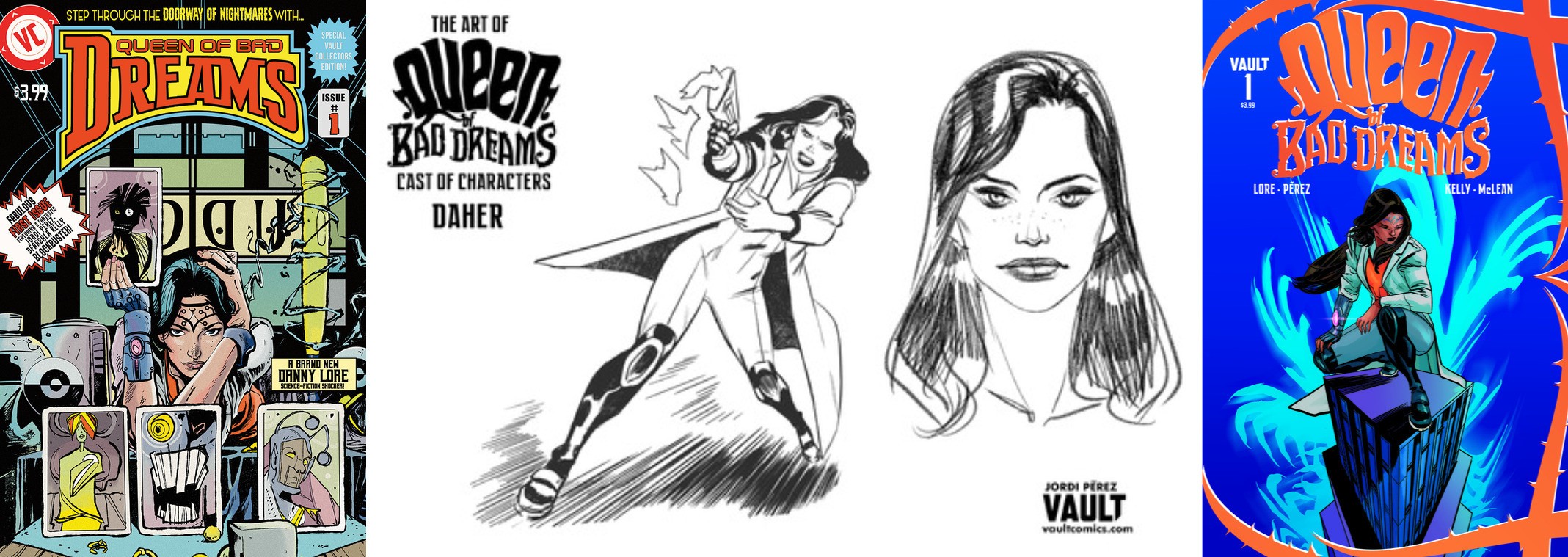
BNP: Living and navigating spaces as a creative that is often knocked into boxes for “other”: a person of color, being Black, a non binary person, etc, there is often so much room for social commentary in the work–what themes or ideas did you definitely want to include in the worldbuilding of QoBD? What nuances do you think other comic creators should explore?
DL: Queen is about living in those boxes. I wanted to build a world where everyone has to think about the question of agency- even those in power. In Queen, even if you don’t want to give marginalized people agency, you have to say it to their faces. You have to constantly be wrestling with that agency.
On the flip side, all of our protagonists are the characters that, in our world, have to think about how much agency they’re going to be afforded/have to fight for. They’re queer and brown, they’re women and non-binary. This is also why Ava, for me, had to be a black woman- because from hair to voices and beyond, there is a particular conversation to be had about how black women are restricted by those in charge.
BNP: I noticed that you focused on the “dream world” as one of the main mechanisms throughout the comic. What inspired you to incorporate the “dream world” into the narrative for this series?
DL: I hope to constantly be in conversation with the other work I see happening in speculative fiction. The original spark of Queen came from the discussion being had in the prose world about HP Lovecraft. People were wrestling with how influential his work was, but what it meant to be brown and/or not male navigating that space. The use of dreamworlds in some of those stories really stuck with me. Add movies like Inception, where I couldn’t help but wonder what would happen if they went even further, and that’s how we got the Morphean Annex.
BNP: What were the main challenges you had while creating the plot and these characters? Also will this comic reveal personal revelations about the different layers of the subconscious on your end?
DL: The hardest challenge for me is always to push myself to be as weird as I want to be! This is a world where dreaming and waking blend, and let’s be real: a lot of people have really weird dreams. I certainly do! At the same time, dreams can reveal so much about us, so I wanted to balance that weirdness with a sense of intimacy.
The way to work through that for me was making sure that every single character is at a different stage of realizing their dreams, and what they want out of them. Once I knew what each of our characters dreams of, I could work with both the outrageousness of what happens when we close our eyes and the intimacy of the things that make us cry- I hope, anyway.
BNP: What art served to influence you during the creation of Queen Of Bad Dreams?
DL: When I was starting to plot, I watched Paprika, Inception, and Bladerunner a lot. I reread Satoshi Kon’s Opus, an incredibly meta-story about inspiration and storytelling I am constantly inspired by. I needed to read and watch stories that bend formats, that go ‘we know what the four walls of the tv/page are, and now we’re going to take a good hard look at how to climb out of them.’ After I started working on the project, I saw Into the Spider-verse and Mob Psycho 100, and they both really changed the game for me on what I could attempt to script. It’s easy, especially as a new creator, to feel as if you can’t play with the rules- so the more and more I see it work out in the real world, the more confident I can be with taking that extra leap.
BNP: Womanhood is not always approached well in comic series, and sometimes if it does, at times it won’t even pass the Bechdel test. What message do you wish to portray in this upcoming series with a femme-centered character?
DL: This is a story that is primarily about women figuring out two things: their dreams, and how to break out of the structures that refuse to let them have those dreams. What I hope to do is tell stories that center women and non-binary characters in ways that make us the stars of our own conversations, and Queen is a part of that hard work, although it is obviously not the entirety of the conversation.
I also wanted this to be a story about brown women and non-binary characters saying ‘it’s on us to support each other’s dreams, so let’s get down to business.’ And I want the men that read this book to be apart of the conversation as well, to really think about how we can make space for each other. We all deserve to have our dreams, and I hope that message resonates with our readers.
Want to get Black Nerd Problems updates sent directly to you? Sign up here! Follow us on Twitter, Facebook and Instagram!With previews out, check out the solicit for issue 2 of QUEEN OF BAD DREAMS from me, @jordi_pz @dearbhlala @_KimDMcLean @thevaultcomics pic.twitter.com/nVoYOCI5Ul
— Danny Loremaster (@weredawgz) February 24, 2019


CommentsNo comments yet
Subscribe for more
Be part of the conversation
Subscribe to Black Nerd Problems to start commenting.
Already have an account? Log in