
Some of Ubisoft’s games don’t run into these issues at all. The Splinter Cell franchise has and always will be about its protagonist Sam Fisher (a better trained and less impulsive Jack Bauer type for those unaware). Splinter Cell even had the icon Lambert played by Dennis Haysbert, who was Sam’s friend and handler for multiple games during the franchise. Even this year’s Watch Dogs (for the all the things it does wrong) portrays its non-white male characters in a pretty authentic way…even if most of them are pretty boring. No, when it comes to Ubisoft and diversity, the conversation probably starts at Far Cry, an unsuspecting then, but huge franchise now for the mega developer. The disposition of Far Cry sets it up for it be a challenge from a representation and diversity standpoint before you even pick up a controller. The first game drops you into the shoes of Jack Carver, ex special forces who finds himself stranded on Micronesia, a series of small islands in the Pacific Ocean. As the game was released in 2004, there was no shortage of movies or shows that contained the Hollywood trope of the white ex-soldier with a dark past suppressing a genocide of indigenous people. Yeah, yeah, we get it. Things began to become a little more overt when Far Cry 2 rolled around in 2008. This time, you were a mercenary in Central America, aiming to take out the Jackal who has plagued the villages. Or more accurately, the The White Devil. You have your “choice” of protagonists this time around with at least one being a person of color, but basically, they’re just skins for your hands when you’re holding guns and don’t factor into the story or gameplay at all. The twist of that game is that the Jackal isn’t actually the devil, but a well-meaning humanitarian that is trying to save the indigenous people from the rival factions. Hella subtle, Ubisoft.

When gameplay finally surfaced and showed the lighter skinned man in question wasn’t white, but actually Asian himself, it helped to stem the criticism some, but the damage had already been done as far as a negative cloud over the game. It also showed that the general public had reached a breaking point of being silent on Far Cry’s imagery and symbolism over the years and wasn’t willing to wait before pouncing on them. I’m not saying that any one should shed tears for the intentions of Ubisoft being mistaken, but that they may have set themselves up to over explain scenarios that might be deemed questionable or insensitive to minorities. Just a few days ago, a spokesman for the game had to come out say that the game was “packed to the gills with women,” even if the playable protagonist is a man. Yeah, its clumsy, but at least they’re trying…you know, something. They could be pretty hair trigger because of their own negative press or it could be because of that Assassin’s Creed thing…
Binders Full of Assassins
Assassin’s Creed, somehow, has become Ubisoft’s number one franchise by a really wide margin. I say somehow, not because that’s implausible for some reason, but because the first game was really, really uninspired. The voice acting was atrocious, it was way too talky and pretentious and completely uneven in its gameplay. However, by most accounts, Assassin’s Creed II was a masterpiece, at least in the ways that it improved upon its predecessor so quickly, ie, not coming six years later as a reboot. Even those early AC years had a some rumblings to them, but they were more aimed at religious representations, as making a game during times of religious persecutions and upheavals such as the birth of the Renaissance or reign of Constantinople will bring that. Things got interesting from a diversity standpoint in 2010 with Assassin’s Creed Brotherhood, where a large component of the game included the recruiting of other assassins. Including women assassins. There was no real distinguishing between the male and female sidekicks and neither of them were particularly well developed anyway, but at least they were there. At least someone thought to think that women could be part of that particular world that not only included being a courtesan or the witty, tech savvy woman who never leaves the office (and yes, Felicity on Arrow fulfills this legacy). But even AC’s multiplayer had playable women characters in it. Without being prompted (at least externally), Ubisoft seemed to be diversifying itself. This culminated in 2012 with the release of Assassin’s Creed Liberation, a launch title for the PS Vita. At long last, you played as Aveline de Grandpre, a young African and French woman in 18th century Louisiana. Wait, what? You got to play as a young Black Woman in the southern United States during the 1700s? Yeah, you did. And it was pretty damn cool. This wasn’t some half baked narrative or a generic plug and play tactic, there was significance to your character and the world around you as a woman of color in that setting. Aveline, who I consider to be the most interesting of all the AC protagonists, had very believable and solid motivations and goals and while mechanically, it wasn’t the strongest AC game, it was a plot that Ubisoft could hang its hat on.
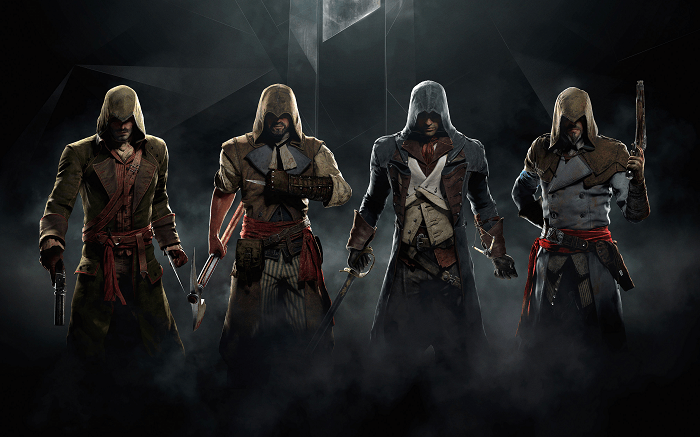
This is why Ubisoft’s stance on their configuration for Assassin’s Creed Unity is so baffling to me. If you haven’t heard the story by now, this year’s AC release will have not one, but four protagonists. All of which will be men. When they were pressed as to why there weren’t any women assassins in the game, the initial response is that it would’ve taken too long in the production cycle and that women were planned to be playable characters in the game, but were ultimately scrapped. This exposes two issues. For one, if true, which I and the rest of the world are pretty skeptical about, shows that the model of dropping another Assassin’s Creed game every year on schedule just validates the criticism that the games are more akin to being pushed through an assembly line for maximum profit as opposed to making outstanding games. Second: What the fuck? Seriously. Diversity just got left on the cutting room floor? That’s really an acceptable answer? Of course an official Ubisoft response after that where it really just spoke about how it has produced characters like Aveline and Adewale (a runaway slave from Assassin’s Creed IV and the Cry Freedom DLC) but spoke nothing for the current lack of diversity for its upcoming game. In other words, stop saying that about us, we have black friends.
#NotAllMenHopefully
It is important to note that Ubisoft is actually a series of Ubisoft studios and that not every game is done by the same production team. Almost all of the huge studios publishers are like this now, which is why every third Call of Duty game is actually good and moving the franchise forward. Still, there is a standard that should be met under the big umbrella that is Ubisoft and when it comes to inclusion, this is just bare minimums at this point. There is a pervasive argument concerning “diversity for diversity’s sake” or how much of the public is actually “affected” by the lack of diversity. This is the argument that always bothered me with the growing discussion around the Washington “Professional Football Team.” If we know something is wrong or excluding another group we shouldn’t be polling to see the exact number of people pissed off about it personally. We should kind of ya know, just do it because its the right thing to do. We tend to talk about how this effects people of color or women that play already play games feeling dismissed, but we don’t talk much about how the monochromatic nature of representation creates an environment where those same people don’t even get invested. And any good model for entertainment or business finds a way to bring new customers into the fold while taking care of its existing. More people are playing games than ever before and seeing how many units Ubisoft moves, they above all, should know that better than everyone else.


Subscribe for more
Be part of the conversation
Subscribe to Black Nerd Problems to start commenting.
Already have an account? Log in