
What haunts you? – An Interview With Rodney Barnes on His Latest Series, ‘CROWNSVILLE’

This transcript has been edited slightly for clarity and conciseness.

BlackNerdProblems: Hello, welcome to our first interview in a while. My name is Mikkel Snyder. I am a staff writer with Black Nerd Problems, and I’m here with Rodney Barnes. How are you doing today, Rodney?

Rodney Barnes: I’m doing well, thank you.

BNP: So, we’re big fans of your work over here. This is dating me a little bit, but I was the staff writer who did the reviews on Quincredible way back when you were with Lion Forge back in the day.

Rodney: Wow.

BNP: Ah, I loved your take on the genre. It was a lot of fun. We also loved Killadelphia a lot when it came out. It was a darling of ours. But we’re here today to talk about Crownsville. It’s coming out with ONI Press November 5th.

So, before we get into that, I guess my first question is, you’ve worn a lot of hats over the years between different mediums, genres, IP work, original stories. What keeps you coming back to comics? And what keeps you coming back to horror?

Rodney: I love comics. And, you know, there’s an idealism when it comes to comics. I work a lot in television and film. And a lot of times that’s business, you know, it’s work. But when I come to comics, it feels like the closest thing to idealism, like what I wanted writing to be in my head when I was a kid and I said I wanted to be a writer. Comics kind of give me that.

In regards to horror, I’ve loved horror my entire life. You know, the majority of my work in television and other mediums has been drama, sports drama, comedies, that type of thing. And being able to speak directly to horror in the way that I want to, comics kind of give me that.

BNP: Because comics is your first love, as you say, is it easier to write for it? Or have you sort of mastered like different parts of it? And it’s sort of like variable?

Rodney: It’s variable, because, you know, in comics, as we were talking earlier, I’ve done superhero comics. I’ve done a lot of Star Wars stuff. I’ve learned a lot of different things. So it’s not like, you know, it’s just horror when it comes to comics. But a lot of my indie work in comics has been horror. So in that regards, yes. But, you know, comics, I just love the medium in general.

Horror, I just love it, you know, as well.

BNP: So let’s talk about Crownsville. How long have you been working on this particular story?

Rodney: On and off for like five years, you know, it was one of those things where I, when I was a kid, I knew about Crownsville, because my grandmother was a nurse there for a while. And, you know, I always looked at it as like the haunted hospital and had a lot of spooky stories around it and all of that. So on and off, different ideas. I didn’t know what my entry point was going to be. I tried a bunch of different things and then ultimately fell into the story that you have now.

BNP: Could you, for our viewers who will eventually see this, could you sort of give like what your logline for what this Crownsville comic is about?

Rodney: In short, there’s a mental asylum that is haunted and the secrets of its past, how it became haunted and, you know, the circumstances that brought it to the place that it is now in my story have come to light.

And a homicide cop and a newspaper man decide to investigate the strange happenings that are going on at the hospital.

It’s closed at the time, like now in reality and in the story as well. It’s condemned. But the events of the past are drawing in circumstances in the present.

BNP: Having read the first couple issues of it, it’s clearly a story that comes from a place of reverence. It’s set in your home state. It revolves around what is an unfortunately American history staple of unethical medical research. How does this feel writing about all of that during a time where we still have a lot of these issues just manifesting in different ways?

Rodney: It was very, very personal. I mean, I didn’t, when I started working on the book, I wasn’t thinking about it in a political sense. I just wanted to tell a really great story.

And circumstances, you know, started to move in that direction as far as what’s going on in the country and how we look at history and how history is going to be taught, disseminated in school, etc., etc. But I wasn’t thinking about that at the time. I just wanted to tell a really good story that I thought was respectful of the place and the people and what they went through.

But it’s almost like everything dovetailed together to where now I get that question a lot was like, was this in response to what’s going on? And, you know, honestly, none of that was in my head. I just always saw the place. And a lot of the stories that I tell Indie-wise are just stories I always wanted to tell.

BNP: How much research goes into a project like this? Because you clearly have like a history with it already. So there was some background knowledge. How much additional effort do you sort of have to like pull in to like give an authentic version of the story in your mind?

Rodney: A good amount. Shout out to Antonia Hylton, who wrote a book called Madness about Crownsville. Probably about a year ago, it came out. Excellent research. And she allowed me to be a little part of it as well. And there are a lot of historians in Annapolis as well who I was able to speak to and a lot of research online. And I actually spent a good amount of time at Crownsville.

First, I almost got kicked off and almost arrested because you’re not supposed to go up there and walk around the place. But there’s a picture you see in some of the press packets of me standing in front of it. Well, that day we almost got locked up for being out there.

Alan Amato, my photographer, shout out to him as well. But a good amount of research and a lot of things that I didn’t know about the place, you know, what it was originally intended for and what it ultimately became.

BNP: Did you have any specific inspirations for Eloise, Todd, and Paul?

Rodney: There were all sorts of composites of characters that I found along the way.

Todd sort of spoke to who I was, you know, when I was coming up and working jobs in the area and all of that. All of these were people who were just like amalgams of a bunch of people who came together, and I needed to make people up along the way. But the sentiments under all of them were real people and real places and real things.

I just, of course, couldn’t use real people that I knew.

BNP: That would be adding a whole other layer to the story.

Rodney: Yeah, exactly, exactly, exactly.

BNP: So we’ve talked a lot about research. How about the other inspirations? So Crownsville clearly has a lot of supernatural elements to it, has a lot of film noir elements to it. What were some of your like benchmarks and your reference works for like the vibe that you wanted to convey with the tone?

BNP: Obviously, The Shining. And ironically, The Exorcist 3. I was a PA for a couple of days on The Exorcist 3 when I worked at Georgetown Law Center in Georgetown, the area where they shot the movie, I was able to work. And if you saw The Exorcist 3 starring the late great George C. Scott, a lot of that was in a hospital. And, you know, I loved haunted houses.

I love that idea of places that still hold spirits and have secrets and all of that stuff. So a lot of it was just kind of mined from movies I’d loved over time and stories that I read that still sort of resonated. There was a great book, Night Stalks the Mansion, when I was a kid that I loved. Amityville Horror, those types of things. And trying to build a sense of mystery and intrigue along with supernatural paranormal events as well.

I wanted to tell a story that wasn’t just a ghost story, but also had a mystery attached to it so that as readers go, they would get to a place where what’s happening? How did we get here? And then the practical problem of how do you solve the problem that’s, you know, that needs solving in the end without giving it away?

BNP: I won’t speak too much about the plot because I don’t want to spoil anything for the viewers, but I think I can talk about the fact that you do a lot of cool things with the timeline and going back and forth between events. And it was really interesting seeing that unfold over the first couple of issues.

Rodney: Thank you. Yeah, there’s a lot of historical stuff around Annapolis just with what it is.

Annapolis and Crownsville are sort of adjacent to one another. So I wanted to get a lot of the history in of how a place like Crownsville could exist culturally as much as practically, you know, how you could have a sense of dread that comes from the people themselves. Like each a cop, a newspaper man, they have histories as well.

And their histories, albeit not directly, are linked culturally to this place as well. So there’s a personal sense of it, even though they’re not necessarily both directly connected to it as people, the background, the environment, the history, they’re connected to that stuff.

BNP: I am also from Maryland. I wasn’t born there. I was a military brat, but I spent most of my middle school and high school there. And I think I’ve driven by the area a couple of times. So it felt very much like this feels familiar in a way that I couldn’t quite place. And part of that…

Rodney: Fort Meade, that Fort Meade area, the Naval Academy, all of that stuff, the military in there. Yep, exactly.

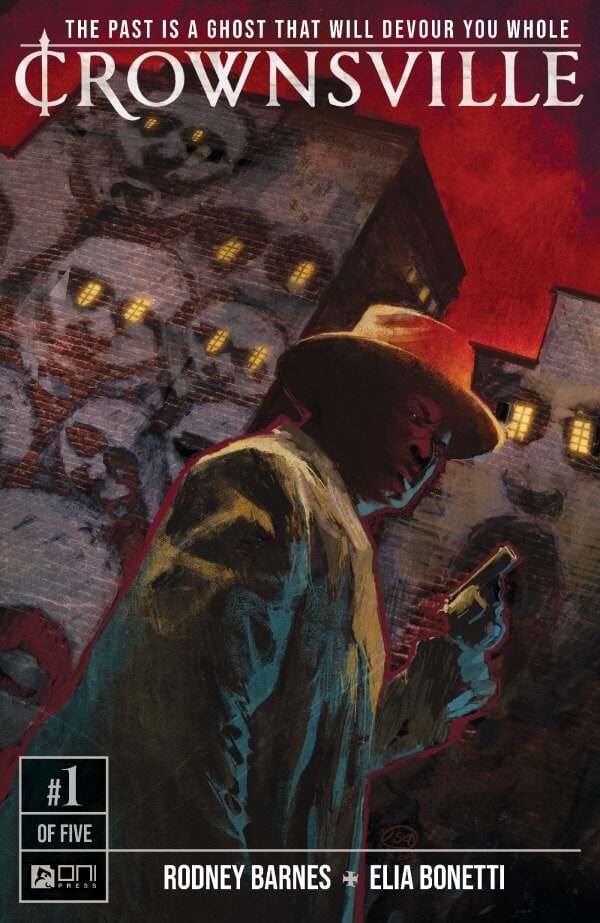
BNP: But part of that, I think, is contributed by your artist, Elia Bonetti, who is absolutely fantastic. What was the collaboration process like with them?

Rodney: I met him through Jason Sean Alexander, who works with me. He did Blacula and he did Killadelphia.

And a lot of times when I’m pitching ideas, I pitch them to Jason and he’ll say, this person would be great artist for it, or that person if it’s not him. And he just felt like Elia would be great as his tone, which is sort of a painted book that feels kind of ethereal and atmospheric. And it adds an element of mystery to it that takes the story beyond the words. There’s a story there within how he decides to create the visuals that words can’t elevate sometimes.

BNP: How different was it collaborating with Elia as opposed to Jason, and a new collaborator versus an older collaborator, essentially?

Rodney: Jason I know like a brother. Jason lives a mile and a half away from me. So I see Jason all the time. I talk to Jason all the time. We argue with each other all the time. So there’s a certain level of familiarity to where Jason and I can have knockdown drag out fights and you see what you see in the end. When you’re dealing with someone via email, who you’re not able to talk to on a regular basis, which is probably 90% of the people I work with in comics, because they’re from all over the world. Like when you were mentioning Quincredible, Selia was from the Philippines.

And I think we spoke one time over the three years and the three volumes of that book. So here was a similar dynamic as well, even though I think we met in New York, at New York Comic Con, maybe two years ago, we met and he gave me some great original art that I got framed and all of that. But as far as in the process of making the book, there wasn’t a whole lot of communication, but immediately he grabbed the work, grabbed the way the script went.

We had a couple of emails between the two of us, but he did a lot of research with the buildings and the things that are online as far as to get the architecture right and the environment right. And just hats off to him. I think he did a fantastic job.

BNP: Do you give that same level of feedback to your letterer? Because there was lots of cool things in the dialogue box.

Rodney; Yes, yes, as well. I mean, I think all aspects of the visual, I think heightened anything that I did with the words.

Like I think the way the book came to life and we’re on the sixth, actually, as we speak right now, I’m due to get the last chapter in. But everything that they did, the visual from the colors to the actual art itself to the lettering, everything sort of just fell into place perfectly. I’m very, very proud of the book.

BNP: How many pages is a typical script that you produce for a project like this?

Rodney. Twenty pages. I do it a lot like, you know, in screenwriting, a page is a minute. So if I’m doing a drama script, typically it’s 50 pages for an hour show.

And if it’s a movie, it’s one hundred and twenty page- anywhere from one ten to one twenty. So my comic scripts really go relatively, you know, 20 pages, 20 pages of script.

BNP: Did you develop your own template that somebody else help you out with that? Did you rely on your screenwriting stuff? Like how did this process sort of like hone over the years?

Rodney: Well, I remember the first script, the first project I ever wrote in comics was for Falcon.

That was my first book in Marvel. And I remember when I turned my first script in, my editor at the time said the script is ponderous. And I knew what the word ponderous meant. And I knew it wasn’t a compliment. And basically what he was saying was it was too many words. And I was writing like a screenwriter for something that really you have to work with.

You know, graphic art is different than the moving image. I didn’t know I’d never considered that before. I just looked at it like I would tell a story like I’m telling any other story.

And it wasn’t until the fourth issue of Falcon that I realized that I have to work with the artist and less is more. And over time, you know, by the time I got to Killadelphia, I started to feel like, OK, I kind of had my own voice and I had my own thing. And I did that both in how I wrote scripts, how I communicated with artists, and ultimately had a better idea of how words and art work together for me in the way that I do it.

And so you’ll find that if you look at those first Falcon books all the way through Quincredible. There’s a lot, a lot of words. And over time, I was able to call it down and say, OK, what’s really necessary? How much do I really need? And leaning on the artist more to really make their choices.

And they know more about this than I do. Jason certainly has been doing this a lot longer than me and really just building a relationship with my artists and trust with the artists, and I’m just trying to say more with less.

BNP: As someone who is naturally very perverse, that is an enviable skill.

Rodney: Yeah, it takes time. It really does take time because you feel like you want to dot every I and cross every T and you want to make sure all the information is there. And then at a certain point, if you do it long enough, and we did 36 issues of Killadelphia and we may do some more in the future, you get to a place where you just develop a rhythm and a confidence that I didn’t have in my earlier stuff.

And now it’s gotten to a place where. I have enough confidence to be able to know how long it’s going to take to write a script, what needs to be said, how I want to say it, you know, I figured out my head before I put pen to paper, and it takes time. But if you do anything long enough, you get better at it, good or bad.

BNP: So that’s a lot of the questions I had about Crownsville and your process. I want to like zoom out a bit, have a little bit fun with this interview. So my next question is: what haunts you these days?

Rodney: Oh, my God. So we don’t have enough time to talk about what haunts me.

You know, primarily. Trying to get to a place career wise where I’m getting everything out of my system. I read an article by Stephen King and he was talking about winding down now because he’s getting to an age where he’s starting to feel old, I guess, where, you know, not so much. I think there’s some mental stuff there the way he doesn’t have the same level of clarity that he had when he was younger, which is understandable. And I have so many stories that I want to tell and so many projects and film and television and comics and just everything, novels across the board.

I don’t know if I’m going to have enough time to get all that stuff out of my system. And now I’m at an age where I’m starting to feel that even though there’s nothing wrong, you know, there’s nothing that I’m aware of that’s going on. But it’s like time has become a lot more valuable and I’m a lot more aware of it than I was when I was young.

BNP: We’ll pivot to a fun question after that existential one. But one of my favorite questions I ask everyone, no matter where I’m interviewing, no matter who they are, I want to know what’s a piece of media you wish more people knew about. Not necessarily your favorite, just something you had more exposure was more in the public consciousness.

Rodney: I think two television shows stand out more than anything else. Homicide: Life on the Street was one of my favorite TV shows in the late 90s. It was the reason that I wanted to become a screenwriter.

It was set in Baltimore. It was about homicide detectives. So, you know, you had death, but you also had mystery there.

And that’s my favorite of any genre to write or, you know, consume. And what else? Night Gallery, Rod Serling’s Night Gallery. You know, Night Gallery didn’t get the same amount of love as the Twilight Zone did.

And I’m a huge Rod Serling fan. And I think, you know, those two pieces of work, I wish had more of a life right now, even though Homicide just got picked up on Peacock, but they changed the music because I guess the licensing and all of that stuff.

So many episodes don’t come off exactly the same as they did when I watched them, but it’s still great stuff. And the late, great Andre Brouwer, who played Pembleton on the show, was actually attached to play Killadelphia in the live action TV show before he passed away. And, you know, but that said, still, Homicide is an incredible piece of work.

And I highly recommend it to anybody who loves dramas, mysteries, Law and Order, Dateline, all of that kind of stuff.

BNP: When it originally premiered on Peacock, I consumed all of it in pretty short order. And it is actively incredible how well it holds up and how well you can see like the foundations for every other cop procedural that followed it after.

Rodney: And yeah, it’s a lot like Kolshak the Night Stalker. It’s a lot like Kolshak the Night Stalker with The X-Files. And you see all the other things that came after it, how one thing inspired a bunch of other things.

BNP: So, yes, I agree a hundred percent. Cool. Well, that’s all of the questions I had for this interview. Is there anything you would like to share for viewers and the audience at home?

Rodney: No, just, you know, if you get an opportunity, check out Crownsville, November 5th. I’m really excited about it, really proud of it. And, you know, it’s got that hometown flavor. So I’m anxious for people to give it a read and hopefully they enjoy it.

Want to get Black Nerd Problems updates sent directly to you? Sign up here! Follow us on BlueSky ,Twitter, Facebook, YouTube, Twitch, and Instagram!

Tags:

  • Mikkel Snyder is a technical writer by day and pop culture curator and critic all other times.

  • Show Comments

Your email address will not be published. Required fields are marked *

comment *

  • name *

  • email *

  • website *